
Reviewed · CHICHEN ITZA TOURS
Chichen Itza: Self-Guided Tour with Audio Narration & Map
What makes this Chichén Itzá experience interesting is that you can explore a world-famous ruin at your own pace, with GPS-triggered audio and an offline map plan. You get a ready route through the site so you are not wandering, hoping you are seeing the “main stuff.”
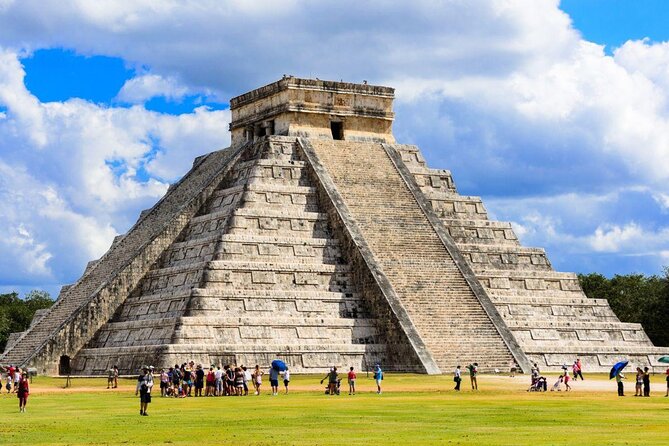
I especially like the offline setup concept, no data roaming required once you download. I also like that the narration ties what you are seeing to clear landmarks like El Castillo (Pyramid of Kukulkan) and El Caracol (the observatory). The main drawback to consider is that you still need to manage your phone battery and walking pace, and the app may start audio a moment before or after the exact spot, so you should be ready to look around and adjust.
Quick hits to know before you go
- Offline GPS works without cellular data after the first download
- Audio plays hands-free as you reach each stop on the route
- El Castillo, ball court scenes, and Tzompantli come with straightforward explanations
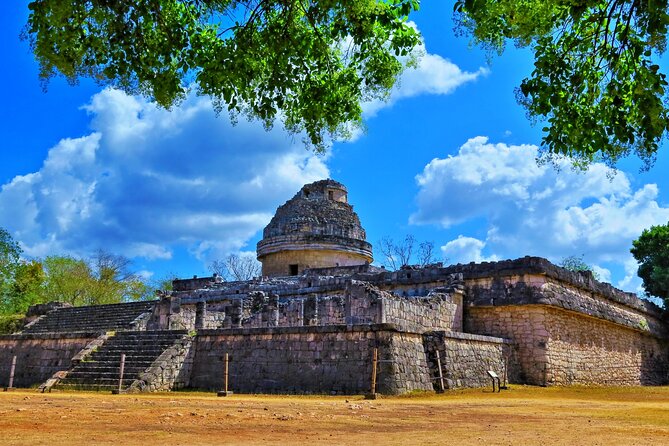
- El Caracol is explained like an observatory tied to star watching
- You walk a lot, roughly 2-plus miles if you do the full loop at a relaxed pace
Value for money and logistics: a guide in your pocket for about $10
At $9.99 per person, this is one of the cheaper ways to get explanations at Chichén Itzá without paying for a private guide. The value is not that it replaces a human guide for every detail. The value is that it helps you understand what you are looking at while you move, especially in places where signage is pretty limited.
Your big separate cost is the park entry ticket. The app itself does not include admission, and some areas are marked as requiring admission, so plan on buying your ticket at the site. Once you have that, the audio tour turns your visit into a stop-by-stop learning route.
The total time usually lands around 2 to 3 hours, with the “essentials” loop around 1 to 2 hours. Also expect over 2 miles of walking if you want to hit the full set of structures.
More ways to see Chichen Itza:
- Chichen Itza, Cenote, and Valladolid Tour
★ 5.0 · 24,293 reviews - Chichen Itza, Cenote & Valladolid Tour with Tequila and Lunch
★ 4.5 · 15,789 reviews - Cancun: Chichen Itza, Cenote & Valladolid Tour with Lunch
★ 4.6 · 6,722 reviews
Setting up so the audio works offline (and GPS actually triggers)
This is a self-guided audio tour using Action’s system. You download the separate Action’s Tour Guide App, then enter a password sent by email and text after booking. The key practical point is that you must download while you have strong wifi or cellular, then it works offline after that.
You are using GPS for location, so your phone needs to behave well. For best navigation, the tour recommends an iPhone with iOS 15 or later, Android version 9 or later, or an iPad/tablet with GPS and cellular connectivity. Bring headphones or earbuds, because audio is meant to play automatically as you pass each story point.
One real-world caution from experience: battery drain is common on hot, sunny days when GPS is running. If you want a stress-free visit, bring a portable charger. Also, the route guidance is good, but the map can be a bit off in places, so if audio starts early, slow down and line up with the next landmark, then continue.
Stop 1: Handicraft Market, a smart warm-up before the ruins
You start at the Handicraft Market area, which is a practical way to begin because you can get settled, grab water or a small snack, and let the tour system get rolling. The stories here frame the land and the lost Mayan world before you jump into the big monuments.
I like this start because it sets expectations. Chichén Itzá is not a museum where everything is labeled for you. It is an outdoor archaeology site where your brain needs a map and a storyline.
If you are very “show me the pyramid first” you might feel the market is a detour. But it is also a good place to pace yourself, especially since later you will be walking more and spending time staring upward.
Stop 2: The official guide zone, with Tu Guía Yucatán context
Next you reach the area tied to Guías oficiales de la Z. A. de Chichén Itzá and Tu Guía Yucatán. This is the moment where a lot of visitors decide whether they want a live guide or go fully self-guided.
Even if you stick with the audio tour, this stop helps you connect the dots. The narration sets up the larger theme: the Mayan civilization as a dominant, advanced Mesoamerican culture. That matters because Chichén Itzá is not just one building. It is a layered place.
More Chichen Itza options side by side
- Chichen Itza: Guided Tour with Valladolid & Cenote Chichikan
★ 4.6 · 911 reviews - Chichén Itzá Guided Tour with Cenote & Buffet at Valladolid
★ 4.5 · 680 reviews - Cancun: Chichen Itza Early Access Guided Tour
★ 4.5 · 616 reviews - Chichen Itza by Van: Reduced Group, Tour Guide, Fast Trip & Lunch
★ 5.0 · 605 reviews
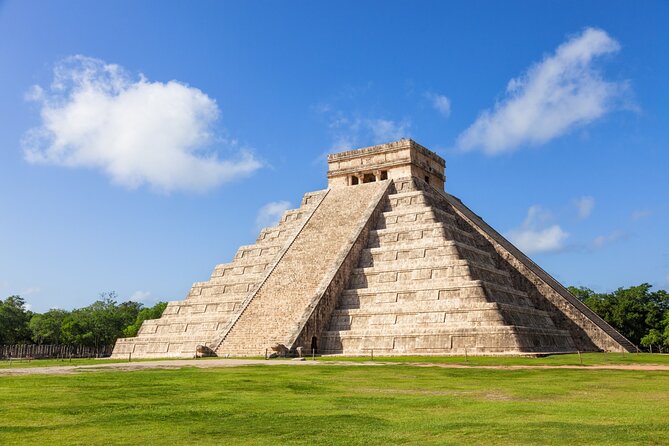
Stop 3: El Castillo, the Pyramid of Kukulkan and the story you can actually follow
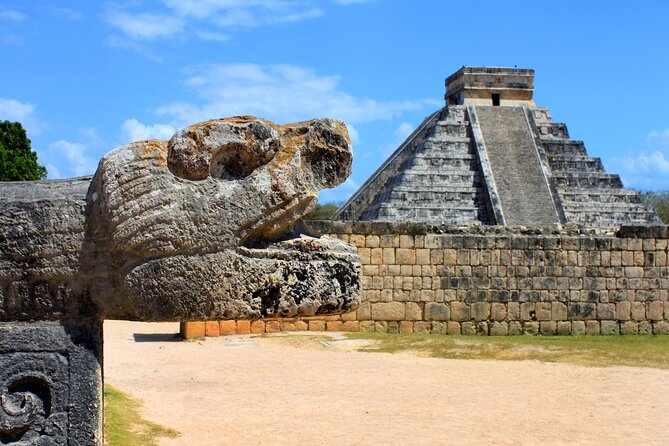
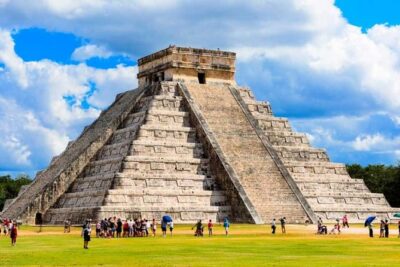
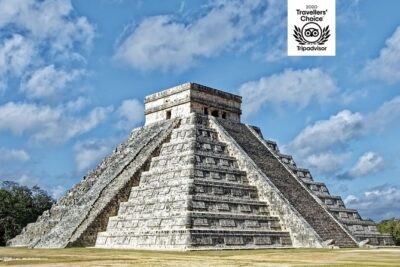
No matter how many photos you have seen, El Castillo hits differently in person. This stop is about the Pyramid of Kukulkan, described as built to honor the snake deity. The audio focuses on how the architecture reflects Mayan civilization and what you should be paying attention to as you look.
I like this stop most when I think of first-timers. El Castillo is where you either get the wonder or get lost in guesswork. The audio gives you a mental hook, so your eyes know what to look for.
Practical note: crowds gather here. Your advantage with a self-guided audio tour is not that you avoid everyone, but that you can step slightly aside, pause, and take in details without having to keep pace with a group.
Stop 4: Gran Juego de Pelota, ball court scenes you can spot if you slow down
Then you head to Gran Juego de Pelota, the ball court. The key detail is that it is not just a field. The tour narration explains how six sculpted reliefs run along the length of the walls.
What makes this stop rewarding is the “look closer” factor. The tour describes how ball players in multiple scenes become visible if you pay attention to the carvings. This is one of those places where you can go fast and miss most of it, or go slow and feel like you unlocked something.
If you are rushing, you will feel underwhelmed. If you take a few extra minutes, it becomes one of the best stops for understanding how art and sport connect here.
Stop 5: Tzompantli, the skull rack as a wall of symbols
Tzompantli is explained as the skull rack, and the audio paints a grim but clear picture of what that means. The narration describes warriors carrying human heads, plus skulls, snakes, and eagles depicted across the walls.
This is the kind of stop where context matters. Without it, you might see stone carvings and just move on. With the audio, you understand the theme: ritual, symbolism, and how the site communicates power and belief through imagery.
One practical drawback: if the light is harsh and you are tired from walking, it can be hard to study the details. Plan to slow down and use shade if you can.
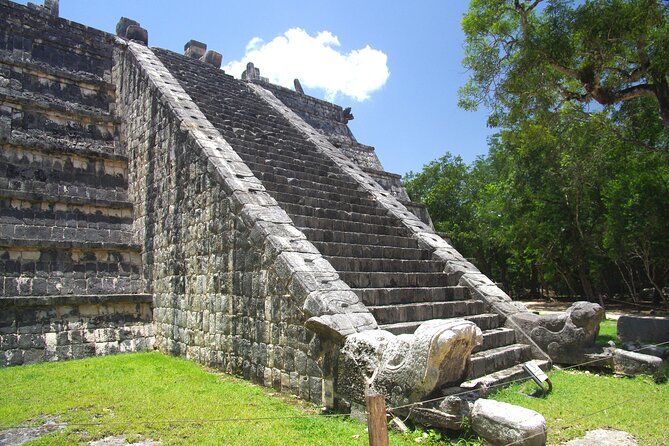
Stop 6: Eagles & Jaguars Platform, a flat ceremonial stage
Next comes the Eagles & Jaguars Platform, a square space with stairways on each side. The audio describes it as likely used for ceremonial purposes like dance, ritual, or public speeches, and it notes it was never crowned with a temple.
I like this stop because it changes the “pyramid only” mindset. You are seeing how the site was used as a stage, not just a backdrop for monuments.
Also, it is a good break point. This part of the route gives you a chance to stand, look around, and let your feet recover for a moment before the observatory themes.
Stop 7 and Stop 12: El Caracol, the observatory idea explained as you move
You encounter El Caracol (the observatory structure) and the audio explains it as one of the more interesting buildings. The narration connects it to star watching, with the Mayans observing the sky and inferring things about the future based on planetary movements.
In the route, El Caracol shows up more than once. That is not necessarily a problem. In a self-guided setup, it can actually help you because you see it from a couple of angles or you catch different details on a second pass.
If you like “science meets myth” thinking, this is a standout. If you just want the biggest photo monuments, you might be tempted to speed through. The audio helps you make the observatory stop feel worth your time.
Stop 8: Chichen Itza Yucatan, a big-picture story that makes the smaller stops click
Chichen Itza Yucatan is where the tour gives you the broad context. The audio explains the site as a major Mayan center of the Yucatán peninsula with nearly a 1,000-year history.
This stop also highlights the fusion of influences: Mayan construction techniques paired with elements associated with central Mexico, creating the Mayan-Toltec feel of Chichén Itzá. The audio also names key structures that have survived, including Warriors’ Temple, El Castillo, and El Caracol.
This is important because Chichén Itzá can feel like random stops if you do not have a storyline. After this, the rest of the monuments feel like parts of the same puzzle.
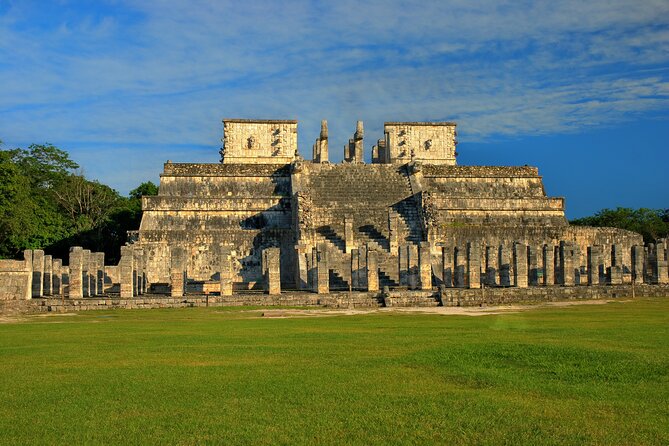
Stop 9: Temple of the Warriors, three tiers and about 200 columns
The Temple of the Warriors is described like three thick tiers at the bottom with a small temple on top. The narration also points out about 200 columns, each with carvings of Toltec warriors in varying scenes.
This stop rewards attention. The columns can look repetitive at first glance, but the audio gives you a reason to keep scanning. You start noticing that the scenes change, and that is where the meaning lives.
If you are going with kids or anyone who gets bored easily, keep this as your “slow down” moment. It is one of the places where listening makes the architecture feel personal.
Stop 10: Red House, latticework and the House of Little Holes
The Red House, also called the House of Little Holes, is explained through its latticework on the top that makes it look like little holes. The tour notes the Mayan name Chichanchob, which could mean small holes.
This stop is great when you are traveling with photo energy but also want variety. It is not as famous as El Castillo, but it is visually interesting, and the audio helps you see how the design creates the effect.
A small drawback: if you only have the energy for a few structures, Red House can get skipped. Do not. It is one of the stops that shows how decorative details mattered at this site.
Stop 11 and Stop 13: The Ossuary and El Osario, bones and high-society tomb ideas
You get two related bone-focused stops: the Ossuary and El Osario. The Ossuary is described as a pyramid named because archaeologists uncovered numerous human remains. The audio says that inside a cavern beneath the pyramid, seven tombs were uncovered and believed to belong to members of Mayan high society.
Then El Osario is described as also known as the Ossuary, called because of human and animal bones found on site, with another name given as the High Priest’s Grave.
These stops are emotionally heavier than the astronomy and sports themes. But that is also why they belong. Chichén Itzá is not only myths and monuments. It is also people, burial practices, and what remains.
Practical advice: go a little slower here. If you rush, the meaning can blur. If you let the audio talk while you stand and look, the stop lands better.
Stop 14: Las Monjas, the Nunnery and texts that mention Kakupakal
Las Monjas (the Nunnery) is described as one of the largest buildings in Chichén Itzá and one of the most archaeologically significant because of the texts inscribed into the walls. The narration adds a concrete name: many of the texts mention a ruler named Kakupakal.
This stop is a good antidote to “only pyramids” visiting. It shows that written records and rulership mattered here, and it makes the structure feel less like a shape and more like a message.
If you love details, make time. The building is large, and you will get more out of it if you listen while you walk the space slowly.
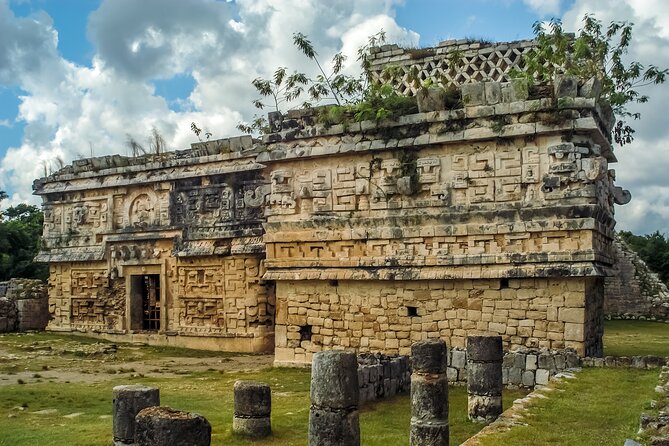
Stop 15: La iglesia, veneer decoration, Chac masks, and tiny animal details
Finally, you reach La iglesia, often one of the most photographed buildings at Chichén Itzá. The audio says its exterior is almost completely covered with veneer decorations, and it describes masks of Chac on two upper stories.
Then it gets fun and specific: among the crowd of Chacs, there are armadillo, crab, snail, and tortoise details. This is exactly the kind of “wait, look again” moment that makes a self-guided tour feel worth it. You are not just seeing a facade, you are seeing what is carved into it.
If you want photos, stay patient. The site is busy, and your best shots come when you find a small gap in the flow.
Timing, walking, and phone habits that keep the day pleasant
Plan on about 2 hours if you listen closely and cover the full route. You can stretch it to 3 hours if you pause often for photos, or if you take more time in shaded zones.
You will walk. That is not a flaw. It is the reality of seeing an archaeological site in daylight. The good news is that there are refreshment stalls and a sitting area partway through the compound, so you can catch your breath.
For audio comfort, bring headphones. The narration is designed to start automatically based on your location, and audio is more enjoyable when you do not miss it.
For battery safety, I strongly suggest packing a portable charger. GPS and bright screens can drain fast, and there is no substitute for hearing the stories in real time.
Also, keep a little flexibility. The GPS guidance is helpful, and if you step off course, the map can help you get back into the trajectory. That said, the guidance can be a bit off at times, so treat the app as an assistant, not a rigid GPS robot.
Should you book this Chichén Itzá GPS audio tour?
Book it if you want a budget-friendly way to understand what you are seeing, especially if you dislike paying extra for a private guide. This tour fits well when you want to avoid group huddles, move at your own pace, and replay segments when something catches your eye.
Skip it or think twice if you need a lot of deep, conversational context. Some people do want a live guide for deeper questions, and the audio stories can feel more “straight to the point” than “endless explanations.” Also, if you are worried about phone reliability, do the download at home first, then bring a charger.
My rule of thumb: if you can handle walking 2-plus miles and you are comfortable using your phone for navigation, this is a smart value.
FAQ
How long does the Chichén Itzá self-guided audio tour take?
It is listed as about 2 to 3 hours. The essentials loop is around 1 to 2 hours, and the full route is roughly a little over 2 miles of walking.
Is the Chichén Itzá entrance ticket included?
No. The tour price does not include the entrance ticket to Chichén Itzá.
Does the audio tour work offline?
Yes. Once you download it, it works offline with GPS alone, with no need for cellular data or wifi during your visit.
What language is the tour offered in?
The tour is offered in English. The materials shown do not list other language options.
Do I need headphones?
For the best experience, yes. Headphones are recommended because the audio is designed to play automatically as you reach each location.
Will someone meet me at the start?
No. You go to the starting point and start touring on your own. The instructions explain that no one will meet you at the start.
What device is recommended for navigation?
The tour recommends an iPhone running iOS 15 or later, an Android device running version 9 or later, or an iPad/tablet with GPS and cellular connectivity.
How do I access the tour after booking?
After booking, you receive an email and text with setup instructions and a password. You then download the Action tour app and enter the password you received.
Can I pause or skip parts of the tour?
Yes. The tour is designed for self-paced use, so you can start and pause when you want and skip anything you do not care about.
Can I cancel for a full refund?
Yes. Cancellation is free if you cancel at least 24 hours in advance for a full refund.
New reviews in from Chichen Itza
- Chichen Itza Early Access Private Tour with Buffet Lunch★ 4.5 · 50 reviews
- Chichen Itza Private Tour – Early & direct Access + Valladolid★ 5.0 · 52 reviews
- Private Tour: Chichen Itza Archeological Zone from Cancun★ 4.5 · 52 reviews
- Mayan Experience in Chichen Itza★ 5.0 · 53 reviews
- Chichen Itzá, Cenote Ik Kil, Valladolid Premium Small Group★ 4.5 · 53 reviews
- Chichén Itzá Deluxe Tour★ 4.5 · 54 reviews
- Full-Day Chichen Itza, Coba, cenote Ik Kil and Tulum Private Tour★ 5.0 · 58 reviews
- Chichen Itza Elite Private Tour from Merida★ 5.0 · 58 reviews
Chichen Itza Tours, compared.
Chichen Itza, Cenote & Valladolid Tour with Tequila and Lunch
Read our review →
Chichen Itza, Cenote & Valladolid Tour with Lunch
Read our review →
Early morning Chichen Itza Tour: Cenote and Tequila Tasting
Read our review →
Chichen Itza Early Access All Inclusive: Hotel Pick up & All Fees
Read our review →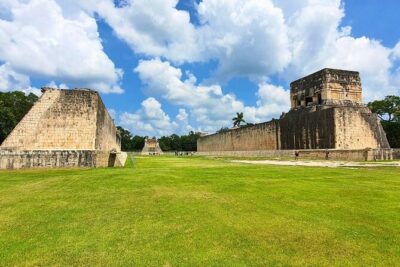
Chichen Itza Gastronomic, Valladolid and Cenote Extremo
Read our review →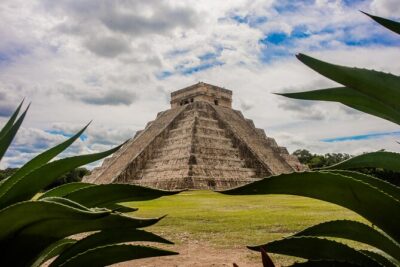
Chichen Itza, Cenote and Valladolid Small Group Day Trip
Read our review →
Browse the lists this tour appears in